
Domestic PaaS Public Cloud
Treat cloud Android instances as orchestration-ready resources: provision on demand, isolate by tenant, and integrate through APIs instead of manual desktop tools.
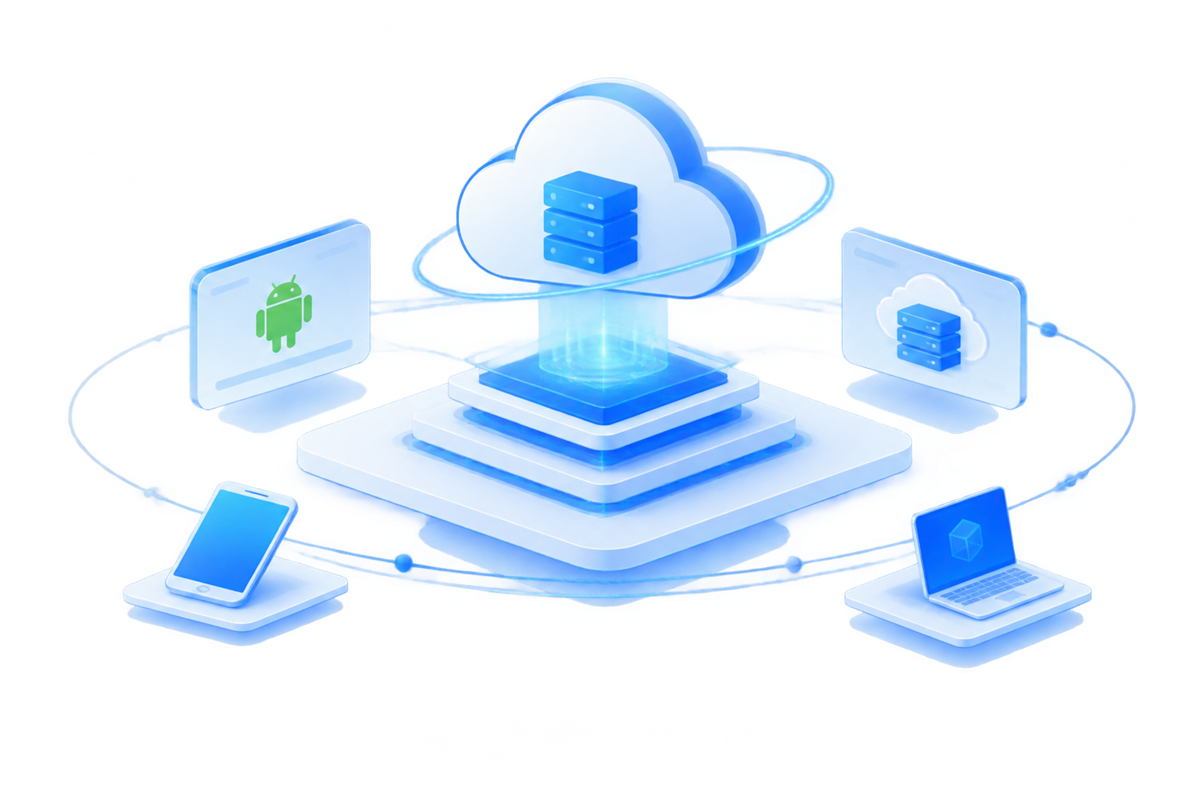
An orchestration-ready mobile runtime
Built for customers who need to run mobile applications at scale without building their own data centre. Compute, system images, runtime instances and operational data are organised into standard resources that a business system can create, configure and recycle through APIs.
- Designed for business systems
APIs, not manual clicks, are the primary interface.
- Metered resources
Instances, storage and bandwidth are counted per tenant.
- Upgrade without disruption
Images and platform versions are separated for staged rollouts and rollback.
Core functions
A description of platform function structure; the exact scope depends on the service edition you subscribe to.
Create instances by image and specification, with batch operations and lifecycle tracking.
Runtime state, resource usage and abnormal events in one view.
Screen and input channels for debugging, inspection and manual intervention.
Configure, restart or switch images across many instances.
Layered storage with published versions and rollback.
Model, resolution and network parameters configurable per tenant.
Initialise the environment on first boot for consistency.
Distribute packages by tenant or group.
Tiered authorisation with auditable operations.
Usage by instance duration, specification and resources.
Tenant scale, resource usage and task execution.
Threshold alerts with callbacks and notifications.
Instances, images, tasks and metering exposed as resources.
Key-based request signing with tenant isolation.
State changes and task results pushed instead of polled.
Examples in common languages to shorten onboarding.
Four-layer technology architecture
A complete layered system from ARM silicon to application services. Layers are decoupled through stable interfaces and support public, private and hybrid deployment.
This diagram explains the technical structure and component boundaries. Actual implementation and delivery scope are defined in the agreed solution.
Specification and delivery
The table describes capability boundaries; specifications and pricing are confirmed through sales.
| Item | Description |
|---|---|
| Architecture | ARM64 compute pool |
| Instance specs | CPU / memory / storage combinations, per provisioning catalogue |
| Images | Standard customised AOSP image; customer-specific builds supported |
| Network | Public access and private interconnect configured per scenario |
| API | REST OpenAPI with auth, callbacks and samples |
| Lead time | Standard services online; custom work scheduled by project |
| Support | Platform-operated maintenance with ticketing and technical support |
Frequently asked
A cloud phone instance delivers an Android runtime as the unit of service, focused on mobile application lifecycle, device parameter simulation and screen channels. A virtual machine delivers a general-purpose operating system.
The console is for debugging and inspection. At scale, integrate instance management through the OpenAPI into your business systems.
Standard APIs and callbacks are provided; adaptation scope is confirmed during onboarding assessment.
Yes. The same platform kernel can be deployed into a customer-owned resource pool.
A managed Android runtime for AI workflows
Use cloud phone instances, images and available platform APIs as the mobile runtime layer for agent development, app testing or training environments. Model and app compatibility are assessed by project.
Need an onboarding assessment?
Share your scenario, instance scale and integration requirements; we will propose a resource and API model.