
One platform kernel, three delivery forms
Domestic public cloud, global public cloud and private deployment share the same platform kernel. What differs is resource ownership, network path and compliance boundary.
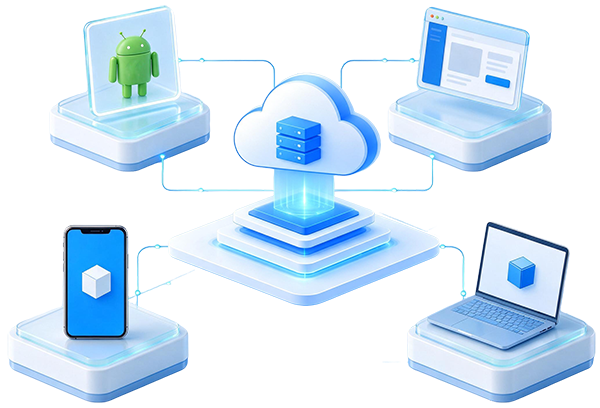
Three product lines
Choose a delivery form by business boundary; combinations are supported as your business evolves.
Domestic PaaS Public Cloud
A cloud Android and compute platform for China-based customers, with on-demand instances, multi-tenant management, image operations, billing and OpenAPI access.
- On-demand provisioning
- Tenant isolation and quotas
- OpenAPI integration
Global PaaS Public Cloud
Multi-region service for cross-border and overseas operations, designed around network latency, data boundaries and local operations.
- Regional node planning
- Cross-border scenarios
- Unified console and APIs
PaaS Private Deployment
Deploy the platform in your own data center or dedicated cloud. Resources stay under your control and data does not leave your boundary.
- Dedicated resource pool
- Data stays on premises
- Localized stack support
Deployment comparison
The core difference is resource ownership and compliance boundary; platform features stay consistent.
| Dimension | Domestic PaaS | Global PaaS | Private deployment |
|---|---|---|---|
| Resource ownership | Built and operated by the platform | Organised per region | Customer-owned or dedicated pool |
| Provisioning | On demand, online | Per region, online | Project-based implementation |
| Network path | Domestic network | Cross-border and overseas access | Customer intranet or dedicated line |
| Data boundary | Managed centrally | Split by region and compliance | Data stays on premises |
| Operations | Platform-operated | Platform-operated | Customer-operated with platform support |
| Typical use | Mobile app hosting, cloud gaming, social ops | Cross-border and local operations | Government, finance, large groups |
Portability comes from a shared kernel
The three forms share tenant model, scheduling logic, image specification and API definitions. Moving from public cloud to private deployment keeps interfaces and operational habits unchanged.
- Consistent APIs
Integrate once instead of adapting to multiple product forms.
- Reusable images
The same image specification works across public and private environments.
- Familiar operations
Metrics and alerting conventions remain the same.
Choose a cloud runtime for mobile business and AI workflows
Compare domestic public cloud, global regions and private deployment by app location, data boundaries and operating model. If you plan to connect an AI model or agent, define the target apps and workflow before selecting the integration path.
Not sure which form fits?
Tell us your scale, data boundary and compliance requirements. We will suggest a resource and deployment model rather than push a specific product.